BBCE States in 2026: Which States Offer Higher SNAP Income Limits?
Over 40 states use Broad-Based Categorical Eligibility to raise SNAP income limits well above the federal baseline. Here's the complete list and what it means for your application.
Wasim Akram
Last updated on
If you have ever wondered why someone earning the exact same income as you qualifies for food stamps in one state but gets denied in another, the answer is almost certainly BBCE. Broad-Based Categorical Eligibility is a policy tool that lets states raise their SNAP income limits far above the federal baseline. The gap is not small either. A family of three might be eligible at $2,694 per month in one state and $4,145 per month in the state right next door.
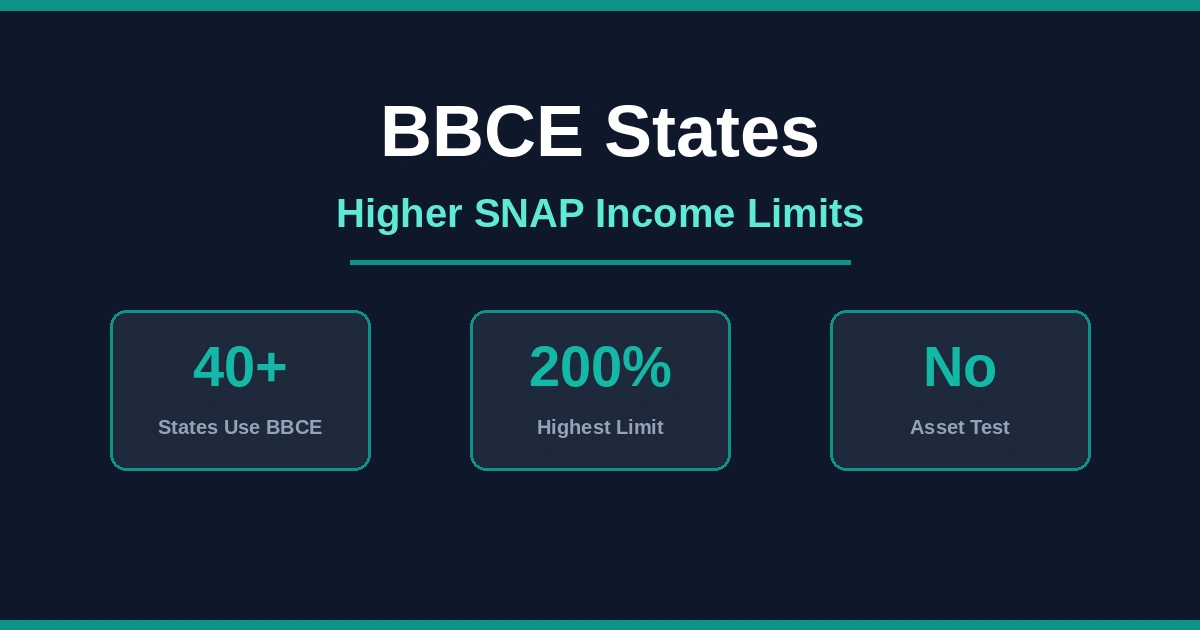
This is not a loophole or a trick. It is a deliberate policy choice that more than 40 states have made to help working families who earn too much for standard SNAP but still struggle to afford groceries. I have been researching SNAP rules since 2018, and BBCE remains the single most misunderstood — and most impactful — part of the entire eligibility system. Let me break it down in plain English.
What Is BBCE and How Does It Work?
BBCE stands for Broad-Based Categorical Eligibility. It is a provision in federal law that allows states to extend SNAP eligibility to households receiving services funded by the Temporary Assistance for Needy Families program. Here is the part that surprises most people: the TANF-funded "service" can be as simple as receiving an informational brochure or getting referred to a job hotline.
States do not have to give you cash assistance. They just have to provide something funded by TANF. By doing this, states can bypass the standard federal gross income limit of 130 percent of the Federal Poverty Level and set their own threshold. Most BBCE states use either 175 percent or 200 percent of FPL.
There is a second major benefit that BBCE provides, and it is one that most people overlook entirely. States that adopt BBCE can also eliminate the asset test. That means your savings account, your second car, and your retirement fund will not count against you. For seniors living off savings, this can be the difference between eating well and skipping meals.
The Income Limit Gap: BBCE vs Non-BBCE
The standard federal gross income limit for SNAP is set at 130 percent of the Federal Poverty Level. Current SNAP income limits for 2026 put that at $1,580 per month for a single person and $3,250 for a family of four. Those are the numbers that non-BBCE states use.
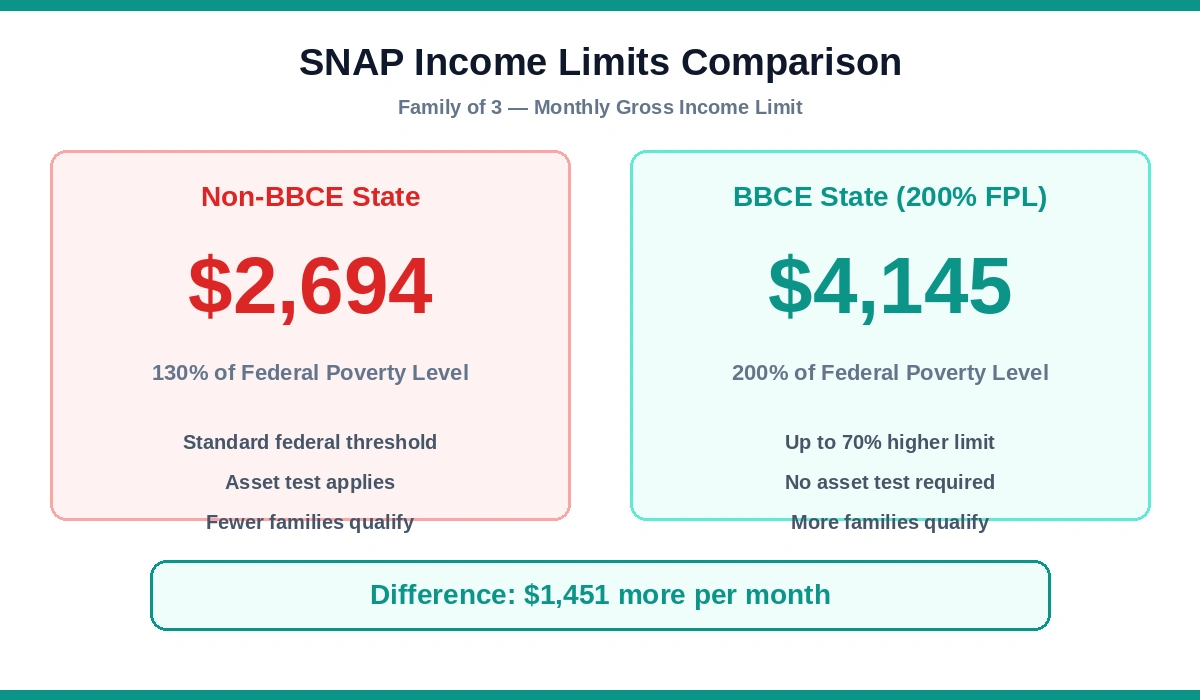
Now compare that to a 200 percent FPL BBCE state. A family of three can earn up to approximately $4,145 per month and still qualify. A family of four can earn up to roughly $5,000. That is a difference of over $1,400 per month in the income ceiling. Same program, same benefits — just a higher doorway to get in.
Non-BBCE State (130% FPL)
Family of 3 income limit: $2,694/month
Asset test applies: $2,750 limit
Fewer working families qualify
BBCE State (200% FPL)
Family of 3 income limit: $4,145/month
Asset test: Eliminated
Many more working families qualify
Complete List of BBCE States in 2026
As of the 2026 fiscal year running from October 2025 through September 2026, more than 40 states plus the District of Columbia operate under BBCE. I have organized them by their gross income limit threshold so you can see exactly where your state stands.
States at 200% FPL — The Most Generous Threshold
These states set their gross income limit at 200 percent of the Federal Poverty Level. A family of three can earn up to approximately $4,145 per month and still qualify for SNAP benefits.
California Connecticut District of Columbia Illinois Maine Maryland Massachusetts Minnesota Nevada New Jersey New Mexico New York Oregon Pennsylvania Rhode Island Vermont Washington
States at 175% FPL — Moderate Expansion
These states use a 175 percent FPL threshold. Still significantly higher than the federal baseline, but the income ceiling is lower than the 200 percent states.
Colorado Delaware Florida Georgia Hawaii Iowa Kentucky Louisiana Michigan Montana Nebraska North Carolina North Dakota Ohio Oklahoma South Carolina Tennessee Texas Virginia West Virginia Wisconsin Wyoming
States at 165% FPL or Lower — Restricted BBCE
These states adopted BBCE but with a more conservative threshold. You get some expansion beyond the federal baseline, but not as much as the 175 or 200 percent states.
Arizona Idaho Indiana Kansas Missouri Utah
Non-BBCE States — Standard 130% FPL Only
These states do not use BBCE at all. The federal 130 percent FPL gross income limit is the only threshold, and the asset test applies.
Alabama Alaska Arkansas Mississippi New Hampshire South Dakota
How BBCE Eliminates the Asset Test
In non-BBCE states, SNAP looks at more than just your income. They also count your assets. The general rule is that your household cannot have more than $2,750 in countable resources, or $4,250 if someone in the household is 60 or older or disabled.
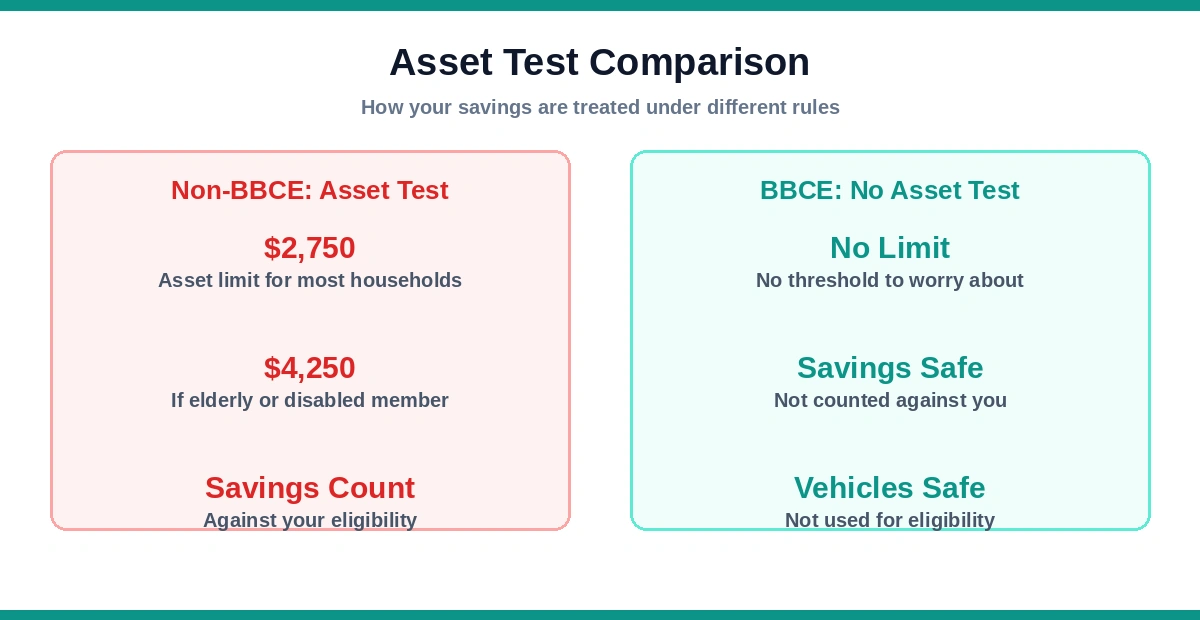
What counts as an asset? Savings accounts, checking accounts beyond what you need for living expenses, stocks and bonds, and sometimes a second vehicle. If you have been diligently saving for emergencies and you have $3,000 in a savings account, a non-BBCE state might tell you that you do not qualify for food assistance — even if your monthly income is zero.
BBCE states typically eliminate the asset test entirely. Your savings, your retirement fund, and your vehicles do not count against you. This is especially important for two groups of people.
Real Example: Same Family, Different Outcome
Let me make this concrete with numbers. Imagine a single mother with two children earning $2,800 per month from her job. She pays $950 in rent and has about $200 in utility costs.
Living in Alabama (Non-BBCE)
Gross income limit for 3 people: $2,694/month
Her income: $2,800/month
Result: DENIED — $106 over the limit
Asset test applies. Her $3,000 savings could also disqualify her.
Living in California (200% FPL BBCE)
Gross income limit for 3 people: $4,145/month
Her income: $2,800/month
Result: APPROVED — $1,345 under the limit
No asset test. Her savings do not matter for eligibility.
Same family. Same income. Same rent. The only difference is geography. In Alabama, she gets nothing. In California, she would likely receive around $400 to $500 per month in SNAP benefits based on SNAP benefit amounts for her household size and income level after deductions.
This is not hypothetical. I hear from people in this exact situation regularly. They applied, got denied, and assumed SNAP was not for them. In many cases, they would qualify if they lived one state over.
How to Check If Your State Uses BBCE
The fastest way to find out is to use our SNAP benefits calculator. Select your state, enter your household size and income, and it automatically applies BBCE limits where they exist. You will see your estimated benefit amount within seconds.
You can also call your state SNAP hotline or visit your state's official SNAP website. The USDA maintains a state directory with links to every state's official page. When you call, ask specifically about categorical eligibility and the gross income limit for your household size.
Recent BBCE Changes and What Might Be Coming
BBCE has been debated in Congress for years. Some lawmakers argue that it expands SNAP beyond its intended scope, allowing relatively high-earning households to collect benefits. Others say it is essential for helping working families who earn too much for standard SNAP but still cannot afford enough food.
The 2018 Farm Bill kept BBCE intact. The 2024 Farm Bill debate included proposals to restrict BBCE, but no restrictions passed as of 2026. Several states have made changes on their own in recent years:
The policy landscape shifts. What is true today may change next year. That is why it is always worth checking your state's current rules, especially if you were denied SNAP in the past. SNAP income limits change every year, and your state's BBCE status might have changed too.
Why BBCE Matters for Working Families
The whole point of BBCE is to reach working families who earn too much for the standard 130 percent FPL limit but still struggle to put food on the table. Think about it this way: the federal poverty level was never designed to capture the actual cost of living. A family earning $2,800 per month in rural Alabama might be getting by, but the same family in Los Angeles would be in crisis.
BBCE gives states the flexibility to account for that reality. It recognizes that a one-size-fits-all income limit does not work across 50 states with wildly different costs of living. Without BBCE, millions of working people who genuinely need help buying groceries would be shut out of the program entirely.
Here is something else worth knowing. When the SNAP benefit formula calculates your monthly payment, it subtracts deductions for housing costs, medical expenses, and childcare from your income before determining your benefit. BBCE households still get those deductions. So a BBCE household with higher income might receive a smaller benefit than a household at the federal limit — but something is always better than nothing.
How to Apply If Your State Has BBCE
Applying in a BBCE state is no different from applying anywhere else. The application process is the same. The difference is that your income will be measured against a higher threshold, which means you are more likely to qualify.
Here is what I recommend:
The Bottom Line
BBCE is the single biggest reason why SNAP eligibility varies so dramatically between states. If you live in a BBCE state, your income can be significantly higher and you will still qualify — plus you will not have to worry about your savings disqualifying you. If you live in a non-BBCE state, you are stuck with the federal 130 percent FPL limit and the asset test.
Knowing which camp your state falls into can save you a lot of frustration and potentially get you benefits you did not know you were eligible for. Check your state's rules, run the numbers through our calculator, and apply if you come close to qualifying. The program exists to help people who need it. If that is you, there is no shame in using it.
Wasim Akram
Independent web publisher and researcher building tools that make government programs easier to understand. Has been researching SNAP and other benefit programs since 2018.
digitalwasim.com